
David Harrison, vice-chair of London Living Streets argues that councils should discharge their statutory duty and powers to keep socially-distancing pedestrians safe by restricting traffic and closing roads.
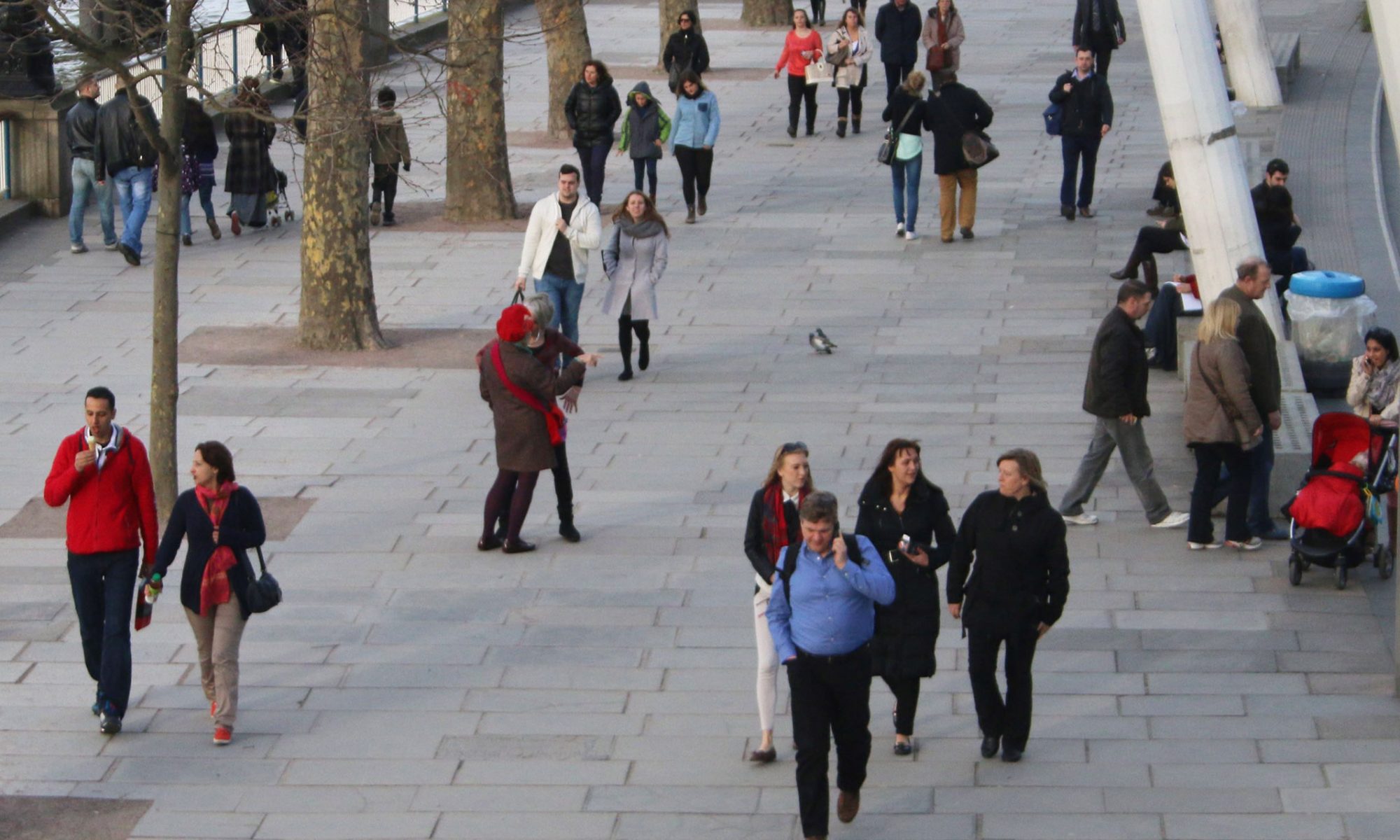
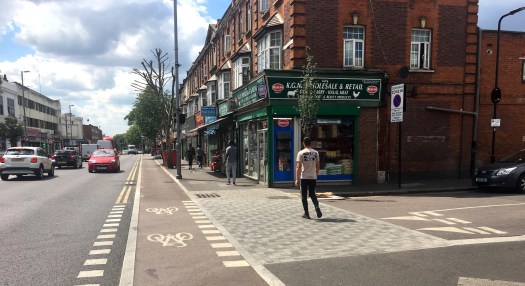
Pedestrians using busy urban streets, or narrow pavements, are having to walk in the road to comply with the Government’s advice on maintaining a two-metre distance. There are streets where people’s lives are being put in danger owing to the speed and weight of the traffic and the narrowness of the pavements. The situation is particularly difficult for elderly people, those with disabilities and children. With motor traffic volumes once again increasing, stepping into the road will become even more dangerous.
This is an important issue. Some local authorities have responded to the situation by restricting motor traffic. Brighton and Hove City Council have closed Madeira Drive. They used their powers under the Road Traffic Regulation Act 1984 (as amended) and all other enabling powers to issue an Emergency (Prohibition of Traffic) Temporary Notice 2020 on 20th of April to introduce temporary closure measures with immediate effect for a period of 21 days. The notice said ‘the closure was necessary to maintain public safety due to an increase in speeding vehicles and to provide a space for exercise’. It made an exception for vehicle access for local businesses.
Others want to take action, but have been advised they cannot. Hackney mayor, Philip Glanville and Jon Burke, the councillor responsible for energy, waste, transport and public realm in Hackney wrote to the secretary of state seeking clarification of the powers available to local authorities. They wrote: “we have been informed by the London Borough of Hackney’s Chief Executive that, following legal advice from officers, it is his view that emergency powers do not allow [Hackney] to implement temporary modal filters and other measures, and that any attempt to do so would be ‘abuse of those powers and be open to challenge’”.
Why have authorities come to different interpretations of the legislation and what powers do local authorities (or other traffic authorities) have?
The key piece of legislation is the Road Traffic Regulation Act 1984. Section 14 (as amended in 1991) states:
“Temporary prohibition or restriction on roads.
(1) If the traffic authority for a road are satisfied that traffic on the road should be restricted or prohibited—
(a) because works are being or are proposed to be executed on or near the road; or
(b) because of the likelihood of danger to the public, or of serious damage to the road, which is not attributable to such works; or
(c) for the purpose of enabling the duty imposed by section 89(1)(a) or (2) of the Environmental Protection Act 1990 (litter clearing and cleaning) to be discharged,
the authority may by order restrict or prohibit temporarily the use of that road, or of any part of it, by vehicles, or vehicles of any class, or by pedestrians, to such extent and subject to such conditions or exceptions as they may consider necessary.”
Of course, it is understandable that officers in LB Hackney are reluctant to use the legislation since it has not been used in this context (a pandemic which requires social distancing) before. However, looking at section 14, it is difficult to understand how Hackney came to its opinion, and that there is not a danger to the public arising from the need for pedestrians to keep 2m apart on pavements that are usually narrower than this.
We ask local authorities to consider three relevant questions:
- Is there any relevant case work?
The closest we can find relates, not to section 14 of the 1984 Act but to section 122. This is the case of Trail Riders Fellowship vs Hampshire County Council in 2019, where similar principles apply, namely that in imposing a temporary restriction or prohibition, the traffic authority should look at factors such as the number of pedestrians, the width of the pavement, the volume of traffic and the danger to pedestrians. Thus, it could be deemed unreasonable to close the Euston Road, but not a street which is not a key part of the traffic network and full of pedestrians doing essential shopping. It looks to us (though we are not lawyers) that an authority might reasonably make such an order. The Court summarised:
It may be helpful to summarise the approach which should be adopted by traffic authorities in considering whether to make a TRO:- 1) the decision-maker should have in mind the duty (as set out in section 122(1) of the 1984 Act) to secure the expeditious, convenient and safe movement of vehicular and other traffic (including pedestrians) so far as practicable; 2) the decision-maker should then have regard to factors which may point in favour of imposing a restriction on that movement; such factors will include the effect of such movement on the amenities of the locality and any other matters appearing to be relevant which will include all the factors mentioned in section 1 of the 1984 Act as being expedient in deciding whether a TRO should be made; and 3) the decision-maker should then balance the various considerations and come to the appropriate decision. As I have already said, this is not a particularly difficult or complicated exercise nor should it be.
- Who might challenge the authority?
a. A resident or a company located in the street subject to the restriction – but this could be addressed by permitting access only.
b. A motoring group – which would probably be unwise for them from a public relations perspective. - What would be the consequences if they were challenged?
a. The local authority could lift the closure order or restrictions.
b. The complainant could refer the authority to the local government ombudsman.
c. The complainant successfully challenges the decision in court as being illegal – either because the section of the act cannot be interpreted to cover this situation, the correct procedures have not been followed, or the decision is unreasonable in the circumstances (such as the closure of a dual carriageway where there is no pedestrian traffic). If the court were to overturn the decision, the council would then have to re-open the street to motor vehicles.
There is no duty to exercise a statutory power, except possibly under a circumstance where it would be wholly unreasonable not to exercise that power. If people are having to step into the carriageway to the danger of their life, and the risk of further burdening the NHS, it might be deemed wholly unreasonable for a highway authority not to exercise its powers.
In fact, section 122 of the Act actually imposes a duty on an authority. It states:
122 Exercise of functions by strategic highways companies or] local authorities.
(1)It shall be the duty of every strategic highways company and] local authority upon whom functions are conferred by or under this Act, so to exercise the functions conferred on them by this Act as (so far as practicable having regard to the matters specified in subsection (2) below) to secure the expeditious, convenient and safe movement of vehicular and other traffic (including pedestrians) and the provision of suitable and adequate parking facilities on and off the highway or, in Scotland the road].
It seems that in the present situation authorities may not be performing their duty to secure the expeditious, convenient and safe movement of pedestrian traffic. So, there might be a case that authorities have a duty under section 122 which could lead them to issue a section 14 order.
Of course, London Living Streets are not lawyers and cannot be certain what the law is. But this is an important issue and will become more so as traffic levels continue to increase, especially if vehicle speeds remain high. It cannot be put on the back-burner or ignored. Lives depend on it.
It would be helpful if the secretary of state were to reassure local authorities as to their powers and duties, but this may not happen for some time. In the meantime, we urge local authorities to think carefully about the powers, which can, as a matter of law, be used in these circumstances, and the duties that they have towards pedestrians.
It is important to remember that those who are least affluent rely most heavily on local shops and services and are the least likely to have access to a car. As a result, they shop frequently and have the highest need for streets that are safe for social distancing and for walking to local shops and services.
Breaking news: we have heard that Lambeth has announced an ambitious Covid-19 Transport Strategy. More information to follow.


 London Living Streets